Sunday, 19 October 2014

THE ORIGINALS SETTLE IN TO BUSTARD CAMP ON SALISBURY PLAIN

As was reported in 'The Times', when the Royal George anchored off Plymouth their arrival was met with the fanfare of bands playing and crowds shouting, 'Hip-Hip-Hurrah!' and singing the anthem 'Tipperary'


Sung with great enthusiasm, 'It's A Long Way To Tipperary' was one of the most popular songs with soldiers on their way to the Western Front in the summer of 1914. It was written by Jack Judge and Harry Williams in 1912 but Patricias likely heard it for the first time upon their arrival at the Plymouth Dockyard. Now sung with pride in the PPCLI Regimental March Past medley, 'Tipperary' has become synonymous with the legacy of the originals.

Three days after docking, on October 18th, the Regiment moved to Bustard on Salisbury Plain and were encamped with the Canadian Division next to the Old Bustard Inn where Division Headquarters was located. The excitement of arrival and eagerness to get to France began to wane, however, as the days wore on. 

 Lt French holding the Ric-A-Dam-Doo with the armed Colour Party,
Bustard Camp, Salisbury Plain

With no communication from the War Office about their future Gault and Farquhar began to get concerned. Now under the command of the Canadian Contingent it appeared the Patricias would be stuck for at least another three months of training at Bustard Camp before joining the fight in France.

Farquhar was also uncomfortable with the possibility the Regiment's NCO's might be pilfered by other Canadian units. As he did in Quebec, by pulling the Regiment out from under the nose of Sam Hughes at Valcartier, Farquhar again set forth to argue on behalf of the Patricias' independence from the CEF in England. For the next several weeks he relentlessly petitioned General Alderson, the Canadian Division Commander to have the Battalion moved.

The worst problem they encountered at Bustard, though, was the weather. They had arrived in England to a beautiful sunny autumn but within a week the driving rains and high winds set in, launching the worst winter in living memory.


Thursday, 16 October 2014

OCTOBER 16TH, 1914, AFTER SOME ROUGH WEATHER AND BEING VERY LOW ON PROVISIONS, THE REGIMENT WAS GLAD TO ARRIVE AT PLYMOUTH

Agar continues his letter of October 12th to Mabel: 


Wednesday 14th.


We have had two really rough days and blowing like blazes, it is now 3 p.m. and we are within a few miles of Plymouth with orders to anchor in the harbour. I don’t suppose we will land till tomorrow.

Friday 16th.

All the transports have now been anchored in the stream off the Dockyard Plymouth. No shore leave and up to noon today no disembarkation – or any other kind of orders have been received. No communication with shore. Buller’s people are in Plymouth and he can’t even write to them. A Naval Officer who came on board told me we were to have gone to Southampton, but they discovered German submarines waiting for us, so sent us on here. We may yet go there. This is a beautiful harbour and chock full of Naval craft of sorts. When we were coming in past the boys training ships, three old oak ships one in front of the other, with bridges connecting, the boys manned the rigging and gave us a cheer. We have no idea what the War Office is going to do with us and can only stand by all packed ready to disembark or go to sea when the order comes. We have for the last 3 days run out of tobacco and drinks of any kind. The weather is beautiful and Plymouth, looks from behind our prison bars, very inviting. 

11 a.m.

The C.O. has just come aboard from a visit to the Commander in Chief and at 12:30 we are going on shore in tugs for a route march returning to the ship tonight. I will post this on the march in a pillar box, also one to Anthony.

Goodbye old girl. I hope you don’t miss me as much as I miss you at all the times. 
Ever thine,

Agar.

This selection of photographs is from an unnamed personal album in the PPCLI Archives. Only the one photo of Talbot Papineau and Hamilton Gault has a caption. Click on each photo to enlarge. 


Talbot Papineau (left) and Hamilton Gault (right)
On board the Royal George


Sunday, 12 October 2014

OCTOBER 12th, 1914, AGAR ADAMSON'S DIALOGUE WITH MABEL BEGINS

Monday, 12th Oct. 1914.

My dear Mabel, 
After 27 days at Levis Camp we embarked on 27 September sleeping on board and training on shore during the day. By the 30th we sailed from Quebec arriving at Gaspe basin on the 1st October, joining the waiting fleet of 20 ships and on the 3rd, the fleet having grown to 31 transports filled with troops or horses we started off in three lines of 10 ships each with Eclipse, Diana, Charybdis, Glory and Talbot convoying us. These have been added to until now we have six more including the Lion, the largest battle Cruiser afloat. Owing to some of the ships being slow, we have not been able to make nine knots an hour, our best day being 216 miles. Each day we go off seven miles to port and seven miles port of us is one of the Cruisers, in the evening we fall in the rear of the column. The Megantic does the same on the other flank. Everything we passed, we made turn about and join us, except ships flying the American flag. Some Canadian bound passengers must have been annoyed. It is really a wonderful sight to see the fleet, we have no news of any kind and no communications between ships is allowed, except orders from the flag ship. All port holes are darkened during the night. If we do not break away tomorrow and increase our speed we are not due in any port till Thursday which will just make the trip 18 days. One ship with 2,000 troops owing to their running short of food made a dash for England last night. We too are pretty short of certain stores. 


N'S

We have had a most wonderful voyage. It has never been half rough, the only real sufferer being Lady Evelyn, it has been quite warm and had one been able to find time, could have sat on deck any day without an overcoat. I have written Anthony a letter which may interest. Will you kindly consider my communications strictly as of a domestic confidential nature as I was much annoyed during the South African war by certain letters of mine appearing in the daily papers and could not have been of any interest to any one not interested in the writer and I object very much to the bright-eyed Canadian idea of wishing for limelight. We have just received a signal from the flag ship to destroy all confidential papers on board. What is behind the order is hard to understand. Two ships full of horses belonging to Canadian troops were ordered last night by the flagship to proceed to France at once. Our Signallers picked this up last night as it was being flashed to these two ships. This looks as if the army wanted horses. It will be very interesting to hear some news when we arrive, as we have been without any for 12 days. It will also be interesting to know where they are going to put us up. The C.O. is certainly trying to get us fit and we never seem to let up, I find he is only 40 years old, quite a child compared to one of his overworked officers. This is really a very nice ship, good public rooms and a wonderful smoking room. It never had a deck taken off, only a Palm Room. I have this from a man who crossed in her before the C.N.R. bought her. Tell Bertie, Captain Ward of ours met him at the Jackam’s house in Hampshire. He is a nice chap who ruined his health in India in the Rifle Brigade and now grows fruit in B.C. Mrs. Gault seems to be a lifelong friend of Mrs. Nesbitt.....


Saturday, 11 October 2014

OCTOBER 1914, LIFE ON THE SHIP

The men in the Regiment had a very enjoyable trip across the Atlantic with calm seas and blue skies until just the last few days when they endured some rough weather. Agar Adamson, who suffered terribly from sea sickness, was prepared for the worst with a good supply of Mothersill's tablets, the most popular remedy of the day. 


With almost luxury accommodations and nightly entertainment it was a comfortable cruise indeed. Adamson wrote home that he had a private room with "a brass bed, all sorts of electric lights, a writing table, in fact everything but a piano and a clock." 

Meals was served in the elegant dining saloon with the officers being piped in each evening in accordance with mess dinner tradition. After dinner, there was usually a concert or games. In a letter to Mabel, Adamson commented on the excellent rendition of 'The Preacher and the Bear' and a delightful pastime called, 'The War Game' played on a board six feet by twelve, that he described as "very much like toy soldiering."


A vigorous training routine continued on board the ship. To maintain the level of fitness the troops had acquired in the month at Camp Levis, each day began with a half-hour run at seven a.m. followed by breakfast. The days were filled with sports and other activities including courses for all troops in map reading and navigation, bridge building as well as in a system of arm signals called semaphore.

Farquhar issued orders that each of the men must learn to speak french under the instruction of Papineau. He was adamant that any officer going to France must have a basic working knowledge of the language. This came more easily to some than others. Gault managed very well with his french lessons but Adamson struggled. He wrote to his son Anthony, "I am in the booby class and am getting on very badly and it is an awful grind".

All in all life was very pleasant aboard the Royal George. Through various sports, lessons, drills and plenty of good cheer the men strengthened the bonds of brotherhood that had begun two months earlier at Lansdowne Park. Only the occasional dead horse thrown overboard from a crowded animal ship served as memento mori, in latin, remember that you must die.


Thursday, 9 October 2014

ABOARD THE ROYAL GEORGE

Among the officers on board the Royal George were a surprising number of women accompanying their husbands, the most notable of which were Marguerite Gault and Lady Evelyn Farqhuar. 


Agar Adamson made reference to the situation in a letter to Mabel whom he envisioned safe at home tending to her duties and their son. In spite of his apparent disapproval he clearly enjoyed the women's company on the journey to England. 

"While there is no doubt women are a mistake on a troopship, (Mrs. Gault) has been very nice generally, she has just missed being quite pretty, sings a bit, is very much in love with her husband, wears a new dress every night for dinner. Some of them very pretty. Gault is an excellent chap, very quiet and hates to be connected financially with the Regiment and is struggling hard to become a soldier."

Marguerite Stephens Gault c. 1915

Mrs. McKinery is interesting in so far that she is a DeWet and Dutch, full of South African money obtained from mines and feathers, but with a very limited range of conversation. Lady Evelyn full of ability, upper gum and sea sickness, she has the red sister to your blue velvet coat with belt bought from Lady Evelyn Ward. She is reported to be very mean, this I know nothing of, and so far have found her most interesting. She is writing a letter to each man’s wife or mother and trying to make them all different, which is quite a difficult job. Mrs. Colquhoun, nee MacKenzie, cousin of Sir W. MacKenzie and a bride of a month, is full of views for the betterment of mankind and future generation, most of them unworkable in Men’s hands."


Lady Evelyn Farquhar 
painted by Sir John Lavery, 1907

Although it seems very unusual by today's standards, every army wife who could afford it joined their husband's on their journey overseas, many, like Marguerite, intending to work with the Red Cross. By 1917, according to the Canadian Annual Review, "about thirty thousand Canadian wives and sweethearts, accompanied by a good many others whose standing was more questionable, had drifted to England mainly for social reasons". Much to Agar's surprise, Mabel would soon follow, but with far more serious aspirations in mind. 

Tuesday, 30 September 2014

SEPTEMBER 30, 1914 THE PATRICIA'S SET SAIL

Newly painted battleship grey, the Canadian Northern Steamship Royal George sailed down the St Lawrence to join the Canadian Contingent and its escorting warships harboured in the Gaspe Basin on September 30, 1914. There they anchored for two days while the full convoy assembled. 

Agar Adamson wrote to his wife Mabel, "After 27 days at Levis Camp we embarked on 27 September sleeping on board and training on shore during the day. By the 30th we sailed from Quebec arriving at Gaspe basin on the 1st October, joining the waiting fleet of 20 ships and on the 3rd, the fleet having grown to 31 transports filled with troops or horses we started off in three lines of 10 ships each with Eclipse, Diana, Charybdis, Glory and Talbot convoying us. These have been added to until now we have six more including the Lion, the largest battle Cruiser afloat."

There were a total of 36 transports carrying 32,000 men, 105 nursing sisters, and 34 chaplains, Adamson reported to Rodney in a letter accompanied by a neat diagram. "We will all start off at once, four abreast, with four men-of-war conveying us, one in front, one behind, and one on each side", although his optimistic description is in direct contrast to reports of chaos on those final days as the first troopships were being organized to go overseas. 

A sense of excitement and wonder filled the air and each new ship that arrived was met with great cheers from the men aboard the others. Sam Hughes, beaming with pride, scurried between ships in a tugboat conveying best wishes and delivering last minute information. The revenue cutter Canada sailed through the fleet, offering to take letters and post them in Halifax. Hundreds of letters were thrown overboard in response but many were carried off into the wind and left floating behind. Talbot Papineau made several pencil sketches of the ships and the river, and these survive among his papers.


PPCLI on board the Royal George


Saturday, 27 September 2014

SEPTEMBER 27th, 1914 THE PATRICIA'S BOARD THE R.M.S. ROYAL GEORGE

After a month of waiting and training at St. Joseph de Levis, an old militia camp on the south shore of the St. Lawrence, the Patricia's received orders for embarkation. Finally the Regiment would set sail for Europe. On September 27th, 1914 they boarded the R.M.S. Royal George.


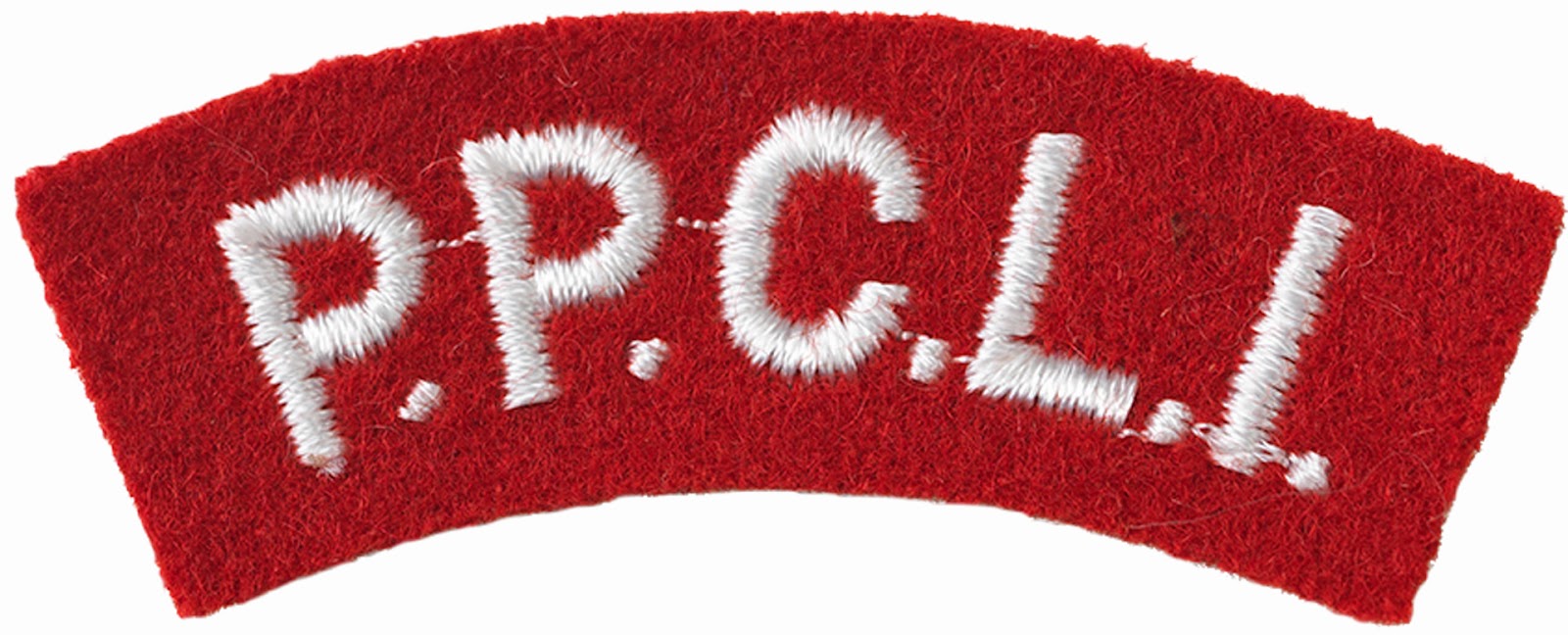
It was at Camp Levis that Hamilton Gault arranged to produce the first batch of scarlet shoulder badges on which the letters 'PPCLI' were embroidered in white. The shoulder titles were made by the Sisters of Charity, the order of nuns established by Saint Marguerite d' Youville in 1752 and the same order of nuns who had knitted for Wolfe's Highlanders in 1759. Gault was aware the Sisters of Charity cared for the wounded after the Battle of Quebec in 1759. In the rest of North America this order is known as the "Grey Nuns." The original PPCLI shoulder titles were modelled after those worn by the British Army from 1902 to 1908. British infantry regiments were directed to wear curved shoulder titles featuring white letters on a red background on their khaki service dress. These uniforms were withdrawn from service in July 1908. 

PPCLI Originals at Camp Levis, Quebec led by Hamilton Gault

The extra month in training had provided an opportunity to straighten out rusty skills or instill non-existent ones. This included siting and digging trenches, advance and rear guards, outpost duties and practicing attacks both day and night. The men spent a significant amount of time on the ranges testing the Ross Rifle, the Quebec-manufactured sporting rifle that Sam Hughes insisted on issuing to all Canadian troops. The rifle was not popular with PPCLI soldiers, the majority of whom had qualified on the British Lee Enfield rifle during their previous service. Although much has been made of the Ross rifle's tendency to jam, the design of its bolt, and its bayonet occasionally detaching when it fired, the weapon suffered from more serious design shortcomings. It was one pound heavier than the Short Magazine Lee Enfield (SMLE) Mark III issued to British soldiers. It was also 15 inches longer, which made the weapon more cumbersome in the confines of a trench system. However, the most significant difference between the two weapons was the magazine. The Ross rifle had a five-round magazine; the SMLE had a ten-round magazine that could be loaded more quickly. 

Ultimately, Farquhar rejected the Ross Rifle before the units' departure for France, the first Canadian unit to do so, choosing instead the standard British Lee Enfield. The rest of the Canadian Expeditionary Force would be burdened with the ineffective rifle until late 1915. "The experience we have had with the Ross," wrote Farquhar in an official memo, "can hardly fail to have shaken the confidence of the men in that rifle." 


Captain Buller and Lt Col Farquhar

The recruiting restrictions placed on Farquhar and Gault meant they weren't able to draw upon the more experienced militia and as such, many of the officers in the original contingent of Patricia's were unlikely choices.

Captain George Bennett, for example, was a former Regina bank clerk and the brother of Conservative Member of Parliament, R.B. Bennett. Selected for service with the PPCLI not due to his military prowess but through his political pull,  he was appointed paymaster.

Captain Charles Stewart, a Nova Scotia bachelor from a prominent family, was another example of an officer selected for his connections to high society rather than for excellence or integrity in past service. Charlie Stewart was known more for his defiant nature and his bold adventurous spirit. His chequered past included expulsion from the Royal Military College for gambling, demotion within ranks of the mounted police for striking a corporal and numerous affairs with women, married and otherwise.

Two of the most unlikely originals, now legendary in Regimental history, are Talbot Papineau and Agar Adamson.

Papineau, an old friend of Gault’s, was the French Canadian great-grandson of Louis-Joseph Papineau, leader of the "patriote" during the Rebellion of 1837. He was the cousin of Henri Bourassa, the arch opponent of French Canadian participation in the War. Papineau, an intellectual, had no military experience whatsoever but had sent a personal telegram to Hamilton Gault asking to join the Regiment, in spite of the very English overtones of the newly formed battalion. Gault accepted his request immediately and Papineau was made a Lieutenant. His Aunt wrote, "Imagine a descendant of Louis-Joseph Papineau the Front. God be praised!"

Agar Adamson was perhaps the most remarkable of the recruits. He was 48 when he enlisted, a decade older than what would normally be consider the oldest of recruits, and blind in one eye. Also born into Canadian aristocracy, Adamson had served with the Lord Strathcona's Horse in the Boer War in 1900 where he discovered a passion for commanding troops in action. The day after war was declared in 1914, Adamson left at once for Ottawa and learned of Gault's plan. The Princess Patricia's Canadian Light Infantry provided a last window of opportunity for an aging Agar Adamson to soldier once again. 

For Papineau, the additional training at Levis was an opportunity to discover how little he knew. "I spend as much time as possible reading my manuals," he wrote to his mother. "The other day I tied my platoon all up and had an awful time getting it straightened out. I seem to get along well with the men but I make a good many mistakes in drill, which is most annoying." 

For Agar Adamson, the month at Levis brought him back to his youth. The officers had all been provided with excellent horses by wealthy admirers and the drills brought out the best in him. 

"We had a great night march a few nights ago," he wrote to his thirteen year old son Rodney. He described in the letter how he had led his company through three miles of thick woods and underbrush, with only a tiny radium-illuminated compass as guide, and emerged triumphantly at dawn precisely at the point where the white flag was posted. "I was quite please with the result", he continued, "because you know that, as your mother says, I can lose my way in the daytime anywhere in Toronto, but it is a different game we are playing just now." He relays, "you can send long messages by moving  your arms in certain directions"  and spoke about a forced march during which he carried "a sword, a greatcoat, a pistol and fifty rounds of ammunition, a blanket, a waterproof sheet, a water bottle, a haversack and a pair of field-glasses" for twenty-seven miles, the last five miles non-stop. There are also stories about the Rugger game with the sergeants, "The next morning I felt as if every bone in my body had been broken," he wrote, "but we won by one goal to a try." 

Adamson took the training seriously and as second-in-command of Company C, earned the respect of his men. He in turn gave them his deep respect. "They are a fine lot," he told Rodney. "They never complain no matter how wet or tired or cold they are, and very often, they are all three."


Pte Thomas Pritchard proudly displaying the Ric-A-Dam-Doo
Camp Levis
, Quebec, September 1914.