Wednesday, 22 April 2015

APRIL 22ND 1915, THE GERMAN ARMY LAUNCHES THE FIRST GAS ATTACK

Major Keenan, the Regimental Medical Officer, was sure he heard the engines of a Zepplin approaching in the late evening of April 12th but the other officers were skeptical. Within a few minutes, though, six massive bombs dropped, some just missing the Patricias' rest camps. A direct hit would have wiped them out entirely. Luckily there was no damage except for the gaping holes in the earth larger than anyone had ever seen before. It was a forecast of things to come.


German artillery and aerial bombing began to intensify mid month. The enemy had brought in their long range heavy guns, the largest mobile artillery pieces in use by any army at the time. These 42 cm howitzers had demonstrated such destructive force at the outset of the war they earned the nickname Dicke Bertha, or Big Bertha, by the German Army. The shells weighed up to 1785 pounds and could project over a distance of almost six miles. Reports from solders say the shells were visible to the eye and sounded like a freight train hurtling through the air. The delayed action fuse could penetrate up to 40 feet of concrete and earth before exploding. The guns were disassembled for transport and reassembled in six hours, requiring a crew of 240 to service and man each gun. Hiding in the forest north of Ypres on April 18th was a Big Bertha Howitzer poised to systematically demolish one of the most beautiful ancient cities in Flanders. 
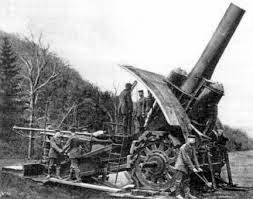

One of the first Big Berthas being prepared to fire

Ypres was bombarded relentlessly throughout April 18th, 19th and 20th. Hundreds of civilians and British troops were killed and wounded in the shelling and it became immediately too dangerous to stay. On the 20th the shelling was so severe the barracks had to be moved outside the city walls. The billeting accommodations in the Cloth Hall were evacuated. 

Adamson wrote to Mabel, “….a very heavy bombardment of the town: a shell fell in my billet backyard, killing two horses and one in the front, littering the whole room and scattering the lacemaking. About one o’clock they commenced firing 15 inch shells knocking down a large part of the town; the large square was littered with debris, and dead and wounded civilians, a great many women and children were killed and wounded. The whole town was a continuous stream of stretcher bearers carrying their loads. Brigade H.Q. badly shelled and moved to infantry barracks. At 4 p.m. we got an order to remove our men from the Infantry Barracks, where they were closely packed with Divisional troops. We took them to a vacant field outside the town and scattered them and watched the shelling of the town. Had it not meant so much to so many people, it would have been a magnificent sight.” 

Patircias worked around the clock helping the wounded and digging civilians out of the rubble. At night they brought food and water as shops were forced to close when the townspeople escaped to safety. Sewer and sanitation systems were destroyed quickly compromising living conditions. Fighting on the front lines had intensified as well and the men were given warning to stay in the Polygon Wood trenches and there they remained, without relief, for the next twelve days. 


Ruins at Ypres 

There had been rumours and warnings of a gas attack but there was a general belief among Allies the Germans wouldn’t use this deadly weapon in the west as the Hague Conventions of 1907 prohibited the use of "poison or poisoned weapons." The Germans had already used gas to great effect on the Eastern Front and the salient presented a perfect target for their next trial with chemical weapons to weaken Allied defences. Gas cylinders with simple hose extensions were installed opposite the French positions in early April. 

On April 22nd, at 5:00 pm, following a heavy bombardment, 168 tons of chlorine gas was released along a four mile front against two French divisions in the northern sector of the Ypres Salient. Canadians to the right witnessed a large yellow-green cloud sifting down from the sky, forcing French troops to flee from their positions. 

German troops penetrated a 4000 yard hole in the line, and advanced through masses of victims. Locals still living in nearby villages and farms were trapped by the toxic fumes with poison gas burning their eyes and lungs, causing respiratory distress and blindness. The Canadian Division was in disarray with telephone lines cut during the severe shelling. Their left flank was wide open yet, inexplicably, German forces halted after a 3,000 yard push into the French position.

Five miles down the line, Patricias, fortunately, were unharmed from the gas as they had not been issued adequate protection. They had been advised to prepare for attack. The Second Battle of Ypres had begun. 


Sunday, 19 April 2015

PATRICIAS TAKE UP POSITIONS IN THE TRENCHES OF POLYGON WOOD

The differences in approach to trench warfare were evident when the Canadians moved into new positions previously occupied by the French. Agar Adamson wrote to Mabel, surprised by the contrast, "It appears the French, who have been here for three months, had a pact with the Germans to live and let live, and did very little firing. When a Staff Officer of the Division came to look over the trenches, he found the French Captain in a very comfortable dugout 400 yards behind, he had never been in the advance trenches and had to get a guide to show him the way. Very different to our system, as yesterday afternoon Buller brought General Smith, a new Brigadier in the afternoon all through the 3 trenches"


British and Canadian officers were harshly critical of the French trench systems in 1915 which were incomplete, shallow and poorly protected. The French officers, relying heavily on their quick firing 75 mm guns, focused less on holding the line than preparing their infantry reserves for counterattack. Whereas the British defensive doctrine was to fully occupy and hold the line at all costs. As such, British criterion for trench design were of a much more rigorous standard than the French. The French routinely dug only two and a half feet down and were content with just one sandbag of depth for the parapet. Also frustrating were the lack of loopholes in the parapets which were essential for viewing and firing without exposing their heads to sniper fire. In spite of the handful of men killed and wounded each day in the line in early April, casualties were considered to have been light in comparison to the relentless and heavy casualties the Regiment suffered at St. Eloi. Many of these losses were due to a lack of diligence at the parapet.

P30(480)-1, PPCLI Originals wounded at Base, Sergeants with Drill Canes c. 1915, courtesy of PPCLI Museum and Archives

Although the decisive action at Vimy Ridge two years later would be credited with launching the birth of our nation, in the spring of 1915 a burgeoning sense of nationalism was emerging among the men. While enduring the unending horrors in the mud of St. Eloi the men had longed for the comforts of home. In quiet moments they escaped into their memories, finding solace in the tranquility of their homeland. So many of these men had been Englishmen living in Canada who, before the war, had not thought themselves as separate from their English countrymen. Once back in Europe, however, it became apparent they had become something other. The lure of the vast wilderness transformed adventurers and aristocrats alike. The easy style and informality of their new lives in Canada had changed their perspectives, even in higher societies. They were different now and a national pride was beginning to emerge. 

There are many stories of men whispering of Canada, of their love of the land, when they took their last breaths. Jack Munroe in his book, ‘Mopping Up’, describes his best friend Rob’s last words, the words he says of “a poet and a patriot; the words of a brooding spirit that had loved its land, and for that land had yielded up the supreme sacrifice”.

"I wish I was back in good old Canada now! Oh, I love the snow! Any place, any spot; from the Hudson Bay to the Great Lakes; from Prince Rupert to the Straits of Canso, would do me tonight. I'm sick of mud!"  No sooner had he expressed this nostalgic sentiment of home that an explosion mortally wounded his friend. With his last faint breath, “Canada....Canada....Canada! my heart...my love....Canada! …. Oh, God....Great Spirit of Truth...my soul....give it back to Canada....let it rest there....in peace, in purity....under the snow!"  

As he lay motionless Jack laments, "his spirit had fled in quest of the Northern Lights; to the silence and peace and purity of the snows."

In the months since leaving Salisbury Plain, the Patricias had not encountered any other Canadian units. As they were preparing in mid April to once again take up positions in the trenches of Polygon Wood, the Regiment were greeted and joshed by another battalion marching through the streets of Ypres. The PPCLI insignia inspired goading, clearly in admiration of the illustrious Patricias. As the men recognized the familiar accent and the cheerful, carefree manner in which these men in kilts conducted themselves their identity became unmistakable. It was a battalion of Canadians that taunted them. Every man instantly broke ranks and rushed to meet each other, against the stern orders of their officers. The mob of yelling and laughing Canucks, half in kilts and half in khaki, enjoyed their fellowship until they were ushered back to order. When darkness fell the Regiment marched again into the trenches of Polygon Wood directly in front of Ypres, along with the rest of the 80th Brigade and the 27th and 28th Divisions. To their left was the Canadian Division, including their new friends from the Scottish Regiment, deployed to the St. Julien sector. To the left of the Canadians were the French 45th Algerian Division. 

There were rumours the Germans would be launching an attack. Adamson wrote, “A prisoner that had been captured had given the information that we were going to be attacked, that gas in tubes was going to be used, that troops were massed in front of us for the attack. We are now supplied with fans and cotton wool soaked in something to revive us, if we are overpowered with the gas.” 


The Ypres Salient on 21 April 1915, showing unit dispositions

Friday, 10 April 2015

THE REGIMENT MOVES INTO THE YPRES SALIENT

Hamilton Gault had tried desperately to get back to his Regiment upon news of Farquhar's death but was under strict medical supervision and, much to his great disappointment, was not given permission to leave. As second in command, Gault was in line to replace the CO and command his beloved Regiment but the opportunity had been denied him. It was now up to Lieutenant-Colonel "Teta" Buller, Farquhar's lifelong friend and fellow member of the Vice Regal contingent from Ottawa, to follow in his legendary footsteps and he did so with stoic and courageous determination. 


Lieutenant-Colonel H.C. "Teta" Buller, D.S.O. 
Herbert Cecil Buller was the son of a British Admiral and aspired to be a career soldier from an early age. At 19 years of age he joined the Rifle Brigade and 29 had been promoted to Captain. At the time the Regiment was formed in August 1914, Buller was one of three British regular officers appointed to the PPCLI from the personal staff of the Governor General, The Duke of Connaught. As the Regiment's first Adjutant he supervised the crucial task of selecting the original battalion. 

A quiet period followed the harrowing events at St. Eloi at the end of March. The men settled into an interval of rest and, for the first time since arriving on the continent, the sun was warm and spring was in the air. So promising was the change of seasons that Adamson sent the matted and dirty shreds of his fur coat and waders back to Mabel.

On April 5th the Patricias arrived in Ypres and were assigned to billets in a large schoolhouse where hot baths and the first change of clothes in a month were a welcome relief. The officers were billeted in a Ladies University which provided some amusement evident in Adamson's letter to Mable describing the assortment of fine ladies clothing and undergarments hastily left behind. 

The city of Ypres was a thriving British and French garrison town in the spring of 1915. A popular tourist attraction and an important strategic landmark, it was also the target of determined German efforts to capture it over the next three years. Critical to the British hold on this sector of the Western Front, the Germans launched a major offensive against Ypres in November of 1914. The town was still relatively intact after the unsuccessful attack although some important landmarks had suffered massive damage. Undeterred, most of the 18,000 civilians continued to live in and around the town in spite of having lost over 250 people killed in the bombardment. The German shelling began to intensify in the area again come spring and in the early morning on April 6th, Germans shelled Ypres directly, killing and wounding 51 Royal Scots and several civilians.

When the Patricias occupied the town just the day before it was still bustling with markets and stores conducting business, almost oblivious to the war raging nearby. But the situation was quickly becoming more dangerous for the local people.


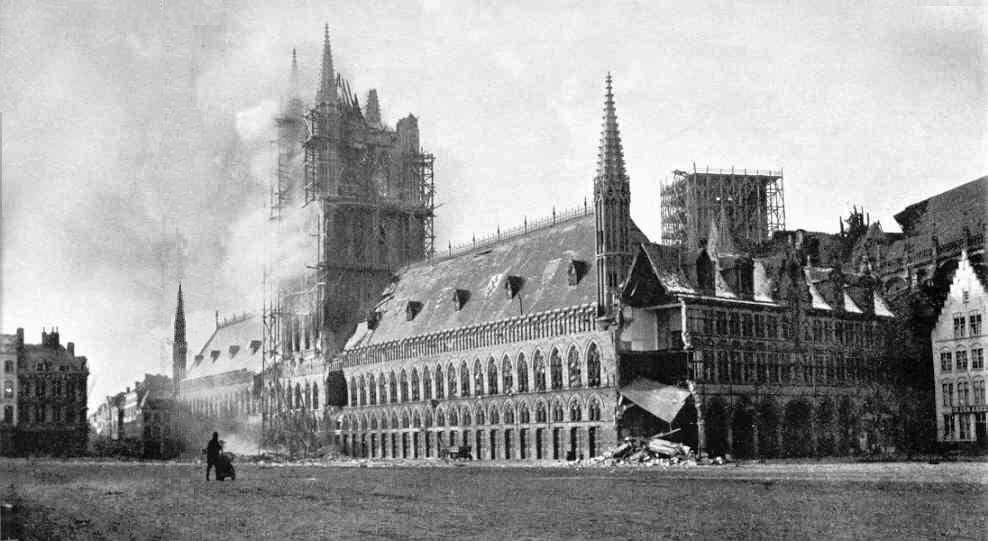
The Cloth Hall burning after a direct hit, Ypres, November 1914

Although the town was still functioning well, the destruction from the November shelling was a constant reminder of the possibility of another attack. The railway station and St. Martin's Cathedral had been badly damaged, among many other buildings, but the historic 14th century Cloth Hall had taken a direct hit. Famous for its gothic architecture, the Cloth Hall had been the original inspiration for the Centre Block on Parliament Hill. One of the largest commercial buildings of the Middle Ages, it was the main market and warehouse for the prosperous Flemish textile industry. Though the roof of the Cloth Hall had been demolished the walls were still standing and was being used to billet up to 1,500 men.

On April 7th the battalion again marched off for the trenches. Positioned in support trenches north-east of Hooge along the southern edge of Polygon Wood, this new location allowed the Patricias a brief respite from the appalling conditions of their previous duties. The trenches were fairly dry and with well sandbagged parapets. LtCol Buller described them as "paradise after St. Eloi."  The landscape surrounding Ypres was not yet destroyed by war and the Patricias were able to enjoy the picturesque countryside. The men were relatively safe here behind the line and wandered over to local farmhouses and village cafes to enjoy the comforts of community. 

Soon the second battle of Ypres would begin. This densely populated region of Belgium would have to be completely evacuated. The historic cities and towns would be subjected to devastating bombardments that would render them nothing more than piles of rubble. The pastoral lands and lush woods would be obliterated and churned into putrid muddy burial grounds. In spite of enduring four years of brutal warfare, remarkably, the city of Ypres never would fall into German hands.


Friday, 27 March 2015

MARCH 24TH, 1915, THE REGIMENT IS WITHDRAWN FROM ST. ELOI

The men were all terribly depressed about Farquhar's death in spite of the effort to keep up morale and good cheer. Gault, still convalescing in England, was devastated when he received the news. With Hamilton Gault, Farquhar had created this fine fighting force and it was a shocking blow for all to lose him. Farquhar's personal leadership qualities had inspired trust and admiration from the soldiers. He had chosen to lead in the field, in spite of the fact he was entitled to a higher position of command. 

Captain Herbert Cecil "Teta" Buller, the Adjutant and now senior officer in the field, was selected to replace Farquhar as Commanding Officer because all of the field officers, including Hamilton Gault, were casualties. He was given the temporary rank of Lieutenant-Colonel. 

Lieutenant Talbot Papineau wrote to Lady Evelyn Farquhar;  

"As a Canadian I feel a great debt of gratitude to him. An Imperial officer who could have commanded the highest position in the English Army, he accepted the task of creating, as well as commanding a new an untried Canadian regiment. He knew well how to combine the discipline and dignity of the British Army with the easy independence and democracy of a Colonial regiment. At all times he exercised a tact and kindness which removed difficulties or overcame them. He, more than any other, has given us a reputation and a standard which we must strive to maintain. I was anxious to do well in order to please him. In the firing line his coolness and courage had great effect on me. I hardly felt any nervousness if I were with him, and I had entire confidence in his judgement." 

Adamson wrote to Mabel; 

"It has been a very dear tour for the regiment. The C.O. and Eardley-Wilmot were killed, the latter only lived a few minutes... Martin of B.C. shot in the arm during the night...Niven badly shot in the elbow. So far I have not got a correct list of the casualties among the men, but they include one of my own men killed and Sergeant Cork. He was in charge of his small body of Regimental Engineers, I spoke to him the first night we were making our trench, he said he had received the chilblain remedy and to thank you for it. He was shot through the spine a few minutes afterwards.

...Poor Buller who must feel (the loss of Farquhar) more than anybody else, insists upon looking on it (as only the fortune of war), personally I cannot and do not see daylight for the future of the Regiment. Buller and I are now the two Senior officers, he is only a youngster and I know my limitations. The Germans still hold the Mound and have made an advance on several of our trenches. We have been compelled to desert 4 we held to two days ago, I doubt if we will get the rest coming to us, as unless we get new troops, we shall require every available man we have to hold the Germans where they are and if they make a determined advance, and it is carried out with any success, we will have to call for assistance from other Divisions....

...When the C.O. was shot he was superintending the placing of barbed wire entanglements in front of a new trench. I had seen him earlier in the evening in the cellar of a blown up house where he made his H.Q. during the day and he detailed my Martin as his platoon to do this work. He said it was a most dangerous job as it was just in front of old 21 which the Germans now hold. Martin was standing beside him when hit and I had a stretcher sent him at once. It was only a few minutes before he was being carried off. Martin was speaking to him when he was shot. The C.O. was talking to Eardley-Wilmot (who we used to call the Child, he was only 18) and congratulating him on having got his 4 Maxims in, carried by his men over the rough ground and placed in position, when he was shot and fell - almost into the C.O.'s arms.

Lieutenant-Colonel Francis Douglas Farquhar is buried in Voormezeele Military Cemetery, Belgium. The British Columbia government honoured him by naming Mount Farquhar after him. Mount Farquhar is located on the British Columbia-Alberta border, Northeast of Fernie.
....We buried the C.O. last night in the dark, 30 of the Regiment, a staff officer represented General Snow, General Fortescue was there in person and although we were subject to sniping fire, not of a dangerous kind, he wished to make a speech to us, but he was unable to do so, as he broke down. But one thing he did audibly say was that apart from being a loss to the Regiment, he was an important loss to the British Army, and a finer soldier or gentleman he had never known. He is buried in the next grave to Cameron and poor Cork is very nearby. 

General French has appointed Buller temporary Lieutenant Colonel and to temporary command of the Regiment. He feels ver uncomfortable about it, but he will get our loyal support and Gault and Pelly will support him. 

All plans have been changed and we get no fairly well earned rest, the whole Regiment goes into the trenches again tonight and in a couple of days the Division moves to some other place. The exact position has not yet been given us and it is very doubtful if we will know till we get there, but one thing is certain, we won't see Westoutre again for a long. 

The shelling of this place let up yesterday, Very little damage done. 
We are making several Commissions from the ranks and have to send them in today. 
We have to cut our kit down again today for the Divisional move. I will try and send some kit back to you. The weather at night is still very cold. Always yours, 
Agar."

As the Regiment prepared to move, Adamson compiled a list of statistics about the Original officers of the Princess Patricia's Canadian Light Infantry to date: 

"Of the Original Officers: 
21 were born in Great Britain
13 were born in Canada
15 were British officers once.
4 were Canadian officers in South African War, 6 British officers had seen service, 5 British were Territorial officers, 1 British officer with no military training and 2 Canadian officers with no military training. 

Killed: C.O., Price, Fitzgerald, Cameron, Eardley-Wilmot, Newton, Ward. 
Wounded: Martin X, Lane O, Martin O, Crabb, Stewart, Niven, Sullivan, Jones, Gault.
Retired: Hayshaw, Court, Smith, French, Minchin RFC, McDougal, Christie
Invalided: Moorehouse X, Lyle X, Bennett, Gray, Carr, Pelly.
Officers now on Duty: Buller, Keenan (Medical Officer), Bainsmith, Papineau, DeBay, Wake, Banning X, Martin O, Clark O, Gow X, Harvey X, Ogilvie X, Edwards X, Isles O, Dennison (joined at Bustard), Adamson. 
Those marked X are from Tidworth
Those marked O are Commissions from the Ranks. 
No Mark - original Officers. 

Of the original regiment the following are at present doing duty. 

Buller, C.O. 
Wake, Q.M.
Keenan, M.O.
Papineau
DeBay
Bainsmith
Adamson

DeBay and Buller are the only officers who have never been away from the Regiment. Among the additional officers; 3 are wounded, 3 invalided home. Note. There are three Martins in the Regiment, two of whom have been wounded. 

Some of the Tidworth officers will tucker out after the first long march. Original Regiment had 34 officers; Killed 7; Wounded 6; Missing 1; Left Regiment 7; Invalided home 5; Sick leave 1; Fit for duty 7; which includes 1 Doctor, 1 Quartermaster. Thus leaving only 5 original fighting officers. 

New Regiment Augmented thus. Commissions from the ranks 5, New officers from Tidworth 10, Dennison joined Bustard 1. Wounded 3 and Invalided 3. Thus leaving out of 48 officers, only 15 fighting officers." 

On March 24th, 1915 the Battalion marched to billets near Poperinghe, Belgium, to the centre of the Ypres Salient, and would never again return to the Mound. In the last three months of fighting to hold the Mound the Patricias suffered 238 casualties. 300 of the Originals were permanently or temporarily gone. 


Friday, 20 March 2015

THE REGIMENT LOSES ITS BELOVED COMMANDING OFFICER

"The King's Royal Rifles relieved us. Back to Westoutre we went for an eight-day rest. Then we were ordered to stand to, while rumours flew thick and fast. Early in the afternoon of the second day in the rest area we received orders to march. It was ten miles to St. Eloi. We made it just before dark. As we passed through Voormezeele we came upon a lot of panic stricken troops. All we could get out of any of them was that there were millions of Germans everywhere, killing everybody. We opened out in extended formation. We fixed bayonets, as we could not fire without doing damage to our own troops, and moved forward to the ruins of St. Eloi. Now we had nothing but the enemy in front of us. We planted our machine guns and started to work. It was Germans at one end of the street and Princess Pats at the other.”
T. Richardson
Letter from PPCLI Museum and Archives 


Between March 10th and 12th, 1915, the first organized set-piece attack was executed by the British Army in the village of Neuve Chapelle. In spite of the fact they were unable to exploit their success in the attack, many valuable lessons were learned but at a cost of 12,000 casualties.

On March 12th the Patricias were settling in for much needed rest. Just as they were arranging to send everyone off to bathe and issue new underclothes the order came in that they were on half hour notice to return to the front. Ablutions were cancelled. The men were ordered to "sleep in equipment" on the night of the 13th. 

The enemy, having held off Sir Douglas Haig's First Army in Neuve Chapelle some 25 miles south, was on the offensive. On the afternoon of March 14th the Germans attempted to gain control of the Mound at St. Eloi. A well planned infantry attack with a heavy artillery barrage succeeded in penetrating the British front line trenches, seizing an important crossroads and gaining the high ground. The Mound and front line trenches, numbers from 14 to 20, were under German control.

A swift counter attack was critical to regain lost ground before the enemy could reorganize and consolidate gains. As the fighting raged, rumours circulated that German troops were advancing in large numbers to strengthen their newly captured position on the Mound. The streets in Voormezeele were full of stragglers from the battle fields, creating panic with "alarmist reports" according to Farquhar’s report in the war diary. 

On March 14th at 7 p.m. the 80th Brigade, or the famed “Stonewall Brigade”, to which the Pats were attached was called up and marched to the front. A rapid advance through the dangerous territory between Voormezeele and St. Eloi was imperative if they were to launch a surprise attack before daybreak. The 82nd Brigade had attempted a counter attack at midnight but failed to retake the line. Farquhar had assessed various strategies of attack and concluded the most effective route of advance would be from the extreme left flank of the Mound. The Rifle Brigade attacked from the right but was unsuccessful in regaining the key positions dominated by Germans. The Mound was now garrisoned with machine guns. A valiant effort by the Patricias against the sweeping machine gun fire also failed to recover the position. It became clear that any further attempts to recover the Mound would be madness and the attack was called off. At 8 a.m. on the 15th the Battalion was withdrawn to Voormezeele and then Dickebusch. The Patricias would never occupy the Mound again. By the end of the month Regiment had been relocated. 

Dickebusch, 16 March 1915

My dear Mabel, 

On the morning of the 14th at Westoutre, we got a half hour stand-by order, then at 5:00 we got a 5 minute standby order and at 7p.m. we go the order to march which we did to as near St Eloi as we can get, as lately it has been so badly shelled that few houses give any shelter. When we got there, we found out the Germans had taken 6 or our trenches and "the Mound", the commanding position we prided ourselves on. At about 3 in the morning we were in position. My Company was divided into two parts as the attacking party, the remainder of the regiment to act as support. Our job was to re-take the Mound and trenches, 19 and 19A. A place called the Breastworks, consisting of sandbag parapets 150 yards from the Mound, was occupied by two officers and 100 men of the Leicesters. The Rifle Brigade, who were in a trench on the right of the Mound, were also to join in the attack if I failed. I took two platoons, 5 and 6, with me with Martin and Harvey, leaving poor Cameron with Platoons 7, 8, behind a ditch. When we were just ready to attack the Mound, we got an order to let the R.B. do it - they lost 150 men, 7 officers killed and failed to take the mound; daylight was coming on. I remained with 5 & 6 with 2 officers in the breastworks and 100 of the Leicesters. Cameron was shot through the neck and killed instantly and three men wounded coming up to fill breastworks. The remainder of the regiment then retired to Westoutre, a Maxim gun opened fire on them killing 10 and wounding 20. Some of the new men got into a panic, and it was some hours before they could be got in hand. 

At daybreak I  found myself with 50 men and 2 officers and 100 Leicesters, plus 2 officers; when I came out the next morning, I had lost 3 men killed, 8 wounded; the Leicesters lost both their officers, 10 men killed, 21 wounded. We all had a good many men suffering from shock and in such a nervous state, they had to be led by the hand. I had a small 3/-periscope on the end of a bayonet which was of the greatest use to me. I took over 3 compartments in the breastworks, two at one end and one at the other and settled down for the day, to see what it would bring forth. The conditions of our trench was terrible, full of dead bodies, more than 21 just beside where I placed myself for the better management of a trench and within 3 feet of me was a good looking, 2nd Lieutenant of the Royal Irish Fusiliers shot through the head. We closed his eye and buried him when night came on. He had nothing to identify him by, beyond the Regimental buttons. 

In front of us and between the enemy and us, about 150 yards, the ground was strewn with dead and unfortunately, many wounded English for whom nothing could be done and those not being able to crawl out at night have to die either of exhaustion or hunger. It seems too awful to think of, but nothing can be done. Even at night you would not have time between flares to get a man away and the Germans fire on all positions. One poor chap in a ditch, made a signal to us that he was alive, we signalled we would try and get him out at night, but conditions changed and we had to leave him.…We have now only 5 of the original officers. The Mound has to be taken and we are now off to talk the thing out with the C.O. and work out a plan of attack. There is some talk of a general advance. 

… Nothing is known of Captain Colquhoun except he is missing. The K.R.R.C. refute having said they found his body in the trenches. ….I am quite fit, but I feel my 49 years and would gladly knock off 20 of them. Everybody is very good to me. I think they realize that youth is a big asset. I am the oldest officer except for Wake who is the Quartermaster. The C.O. is only 40. Please keep the photos or film I enclose in another letter. Always thine. 

Agar. 

Lieutenant Charles Stewart critically wounded not expected to survive, March 14th, 1915
Lieutenant P.E. Lane wounded March 14th, 1915
Lieutenant Donald Ewen Cameron, killed in action, March 15th, 1915
Major James S. Ward died of wounds March 1917th, 1915.

On the night of March 19th/20th Colonel Farquhar was struck through the chest by a bullet while handing over command of the front to the relieving battalion. He was rushed back to the dressing-station in Voormezeele but the wound was fatal and he died three hours later. The following night he was buried under cover of darkness in the Regimental Cemetery outside Voormezeele that he  himself had petitioned for. The surrounding fields were under constant fire but the ceremony was conducted in spite the high risk. Only forty of all ranks were given permission to attend and the higher ranking officers were ushered through the cemetery to pay their respects in small groups of two of three. 

Regimental Cemetery at Voormezeele, 1915

The loss of the Regiment's beloved Colonel was a severe blow to the men. As the co-founder of the PPCLI, Lt Colonel Francis Farqhuar had been among the greatest of commanders who chose to lead his men in the field, inspiring them daily with his own courage, grace and good cheer in the face of constant hardship.  


Lt. Col Francis Farquhar's headstone, Vooremezeele Cemetery

Thursday, 19 March 2015

IN THE WAKE OF THE TRENCH RAID

The trench raid, though it accomplished little in practical terms, had been an important operation in boosting the morale and confidence of the men. There were hard losses but for the first time the men had been on the offensive rather than the usual routine of helplessly taking cover against the constant shelling. They surged with pride at their daring and the accomplishment had been well noted in high command and perhaps even more significantly, well reported in the newspapers abroad. At a time when the lack of reinforcements threatened the Regiment's very existence, the reputation of leadership and courage in the field contributed to securing its future.


Both Papineau and Crabbe had earned the new decoration for junior officers, the Military Cross, and were the first Canadians to do so. Hamilton Gault was awarded the first Canadian DSO for his heroic rescue of the wounded soldier.

Having just arrived, Agar Adamson was initiated into action on the day of the trench raid. Even more shocking, he found himself in Trench 21, the most vulnerable and hostile trench in the Ypres Salient. Over the next weeks he wrote to Mabel virtually every day with lengthy descriptions of his encounters. In his letters, Adamson kept detailed accounts of the dead and wounded along with graphic descriptions of the horror. In the next breath he would make lengthy requests of Mabel for new supplies. 


“My Dear Mabel, 

It is beyond my powers to describe what has happened in the last 4 days, but I know if I read what I am going to write, I doubt if I would be able to believe it was not written by a liar or the ravings of a maniac. In my trench I lost 6 killed, 21 wounded, the Regiment lost 17 killed, 46 wounded. Poor Colquhoun who went out alone in the dark to place his snipers, never came back. The Kings Royal Rifle Corps report having found him in the German sap in front of trenches with 6 bullets in his head. Crabbe, another officer who led the charge, had 3 fingers shot off. Major Ward shot through the head is still alive but paralysed down one side. Major Gault who tried to rescue a wounded man after the stretcher bearers had to desert, went out with another man to rescue him in broad daylight, which they succeeded in doing, but Gault was badly hit in the wrist, he still carried on for 24 hours until the C.O. insisted upon his going back to England for treatment. As Keenan said, complications were sure to set in if he didn't get absolute rest and quiet, it almost took force to get him to go. He has played the game magnificently, night and day, crawling from trench to trench and cheering up the men.

…I have lost everything I took into the trenches; revolver, compass, torchlight, canton, webb equipment, rucksack, haversack and their usual contents. We had to leave everything behind as we were all so stiff and swollen that we could not carry anything. The men had to leave their greatcoats and equipment behind and in many cases, their rifles as it was a case of swimming. A man's greatcoat when wet through weighs 90 pounds. I came out with waders (the ones you gave me) a fur jacket and mackintosh. The water got inside my waders which added to my discomfort. The march from here to the trenches was only 4 miles, but over cobble pavements, all cut to pieces by the traffic, my feet were badly bruised as the sole of a wader makes a very bad sock. I had on a pair of socks under and over my waders and needing very large boots, the socks, creasing up and becoming hard, cut into my feet. The suffering of the men is very great after they came out of the trenches; their feet and hands all swelled and a stiffening of their joints set in. They rub each other to get the circulation and then a curious tickling sensation sets in and lasts about 24 hours. During this time the men are unfit for any kind of duty. That is why we can only stand a 48 hour go and I doubt if 24 would not be wiser.” 

…Keenan is proving himself to be very sound and kindness itself to the really sick.…I found the other day that opium was of great effect in relieving wounded men and putting them to sleep - until night comes. Send me a few capsules. One poor chap never woke, but I think he would have died anyway and it made it easier….It is very difficult in dressing a wounded man in a bombardment trench, his clothes are very tight owing to being soaked. For instance, a man shot only with one bullet in the shoulder. You cannot take off his fur coat, his serge, his shirty and vest to get at him. It is too painful and really quite impossible, so you cut it off with a knife and this is most difficult and few men have really sharp razor blades or knives which are required. The only thing to do is to give him opium and then try and pour two iodine capsules over the place which is often impossible to see as you cannot use a light; the moon helps. You then use safety pins (which all men carry) to fashion together part of his cut clothing. One with tight breeches had to take his chances and so far is not infected. One sergeant of the draft, had shrapnel all over the face, bled from what looked like 20 different places, refused to be touched an in an hour’s time the bleeding had stopped and beyond looking an awful sight and being a bit groggy he was able to get out of the trench in the dark alone and has only gone to the rest camp. One man with his leg blown off clean above the knee was carried out several hours afterwards (about 5 hours) and did not bleed to death as would be expected. Although it looked as if he must bleed to death at once. I did not see this man. Ask your lecturer why. I think every trench should have a medical student and many lives might be saved. Ward is still alive, had an operation to remove the pressure of the skull against the brain. Keenan is optimistic. 

Goodnight dear old girl. 
Agar"

Aggressive artillery assaults from the enemy intensified in the wake the raid. The Regiment had stirred up the hornets nest and the Germans were not going to let it go quietly. After ten days of relentless retaliation, more casualties, and constant activity by Patricia work parties on trench repair, the battalion finally marched to their billets in Westoutre for well deserved rest. Shortly after they arrived they were put on half hour notice to return to St. Eloi. The 82nd Battalion in the front line trenches had been overrun by the enemy. 

St. Eloi, Winter 1915


Sunday, 1 March 2015

THE AFTERMATH OF THE ATTACK

The attack on the German trench was over in just twenty minutes but the Patricias felt satisfied, casualties notwithstanding, that the enemy had been dealt a significant blow. A surge of Regimental pride swept through the men who were inspired by Hamilton Gault's fearless leadership on the battlefield. 


Even with the full light of the moon, Gault had managed to prowl undetected across no man's land to the rear of the German position, surveying their trench system to bring back valuable information. He was later wounded while carrying one of his fallen soldiers back across open ground under heavy fire but stayed with his men for twenty four hours before reporting to the 87th Field Ambulance. His injury was diagnosed as a 'gunshot wound, right arm, severe.' 

Shorty Colquhoun had not been so lucky. When he returned to the German trenches to gain more intelligence that night he was cornered in one of their communication trenches, captured and taken Prisoner of War. The first Canadian Officer to be detained by the Germans, he stunned his captors with his great height. The Germans interrogating him asked him nervously if he was taller than the other men in his Regiment. He replied casually that his six foot, six inch frame was just an average size for a Canadian soldier. 

This photo of Brigadier General "Shorty" Colquhoun (with veterans of both World Wars at Fort McLeod in 1964) reveals his towering height. 


The results of the raid were moderate with German casualties being similar to the Patricias'. Approximately forty yards of well constructed enemy trench was destroyed but the greatest gain was the spike in the men's morale. On March 1st, however, the vengeful enemy punished the Patricias with heavy fire all through the day. The bombardment was so devastating that some parts of the line had lost as much as seventy five percent of their fortifications. By the end of two days of operations the Regiment had sustained over seventy casualties.

Talbot Papineau had been one of the ninety or so men chosen to participate in the raid. He describes the experience in a letter to his mother. 

"We have made an attack at last and I have led it," begins Papineau in a letter to his mother. "The moon was well down and dawn was coming. The colonel said, 'There are six snipers that will go ahead of you then you will go with your bomber-throwers. Crabbe will be behind you with his me. All right! Lead on!' I was pretty scared! My stomach seemed hollow. I called my men and we fell into line and began creeping forward flat on our bellies. I had a bomb ready in my hand. We lay for a moment exposed and then suddenly we were all up and rushing forward. My legs caught in barbed wire, but I stumbled through somehow. I set my fuse and hurled my bomb ahead of me. From that moment, all hell broke loose. I never thought there could be such noise. I had my revolver out. A German was silhouetted and I saw the flash of his rifle. I dropped on my knees and fired point blank. He disappeared. I said to myself, 'I have shot him.' I fired into the trench at whatever I thought was there. Then my revolver stopped. I lay flat and began to reload. I was against the German parapet. I looked behind me and could see only one man apparently wounded or dead near me. I thought, 'The attack has failed. I am alone. I will never get out.' A machine gun was going and the noise was awful.

Then I saw Crabbe coming. He knelt near me and fired over me with a rifle. I had got a cartridge home by this time and Crabbe and I went over the edge into the trench. It was deep and narrow, beautifully built, dried by a big pump, sides supported by planks, looked like a mine shaft. A german was lying in front of me. I pushed his head down to see if he was dead. He wasn't. I told a man to watch him. Then I began to pull down some of the parapet and sandbags. Three or four men were there too with shovels. The German machine guns were going like mad. It was beginning to grow light. Presently we were told to evacuate the trench. I passed the order, then climbed out and made a run for our own line. Another man and I went over head first. The man that came after me was shot through the lungs. The next man got it in the stomach. They fell on me in the mud. I could not budge. Then over on top of us all came a German! He held up his hands and a couple of our men took him away. Gault was there and he worked pulling the wounded men off each other. One or two men came piling over with fixed bayonets and almost put our eyes out. I was finally pulled out of the mud. It was to quite light. I had to get back to my own trench. I beat it across the open expecting to get it any minute. I was so exhausted I wobbled from side to side in the mud. However, I reached home and dived for cover. I was tired but mostly glad to be back. 

The stretcher bearers were carrying the wounded out past the back of my trench. The last party got halfway, then dropped their stretcher and ran. Gault crawled out to the man with a couple of volunteers and they dragged the stretcher into a ditch and then to a hedge. Gault was shot through the wrist. He will probably get the VC."

Two days later Gault was evacuated to the 11th General Hospital. On March 5th he sailed on the hospital ship St. Andrew to Folkestone where he was admitted to the Queen's Canadian Military Hospital. Two weeks later he was sent on leave to spend time with Marguerite in London. 

Talbot Mercer Papineau with his dog Bobs, 1915
Major Gault, Lieuts. Colquhoun and Papineau
were all decorated for their actions on February 27th/28th, 1915