Sunday, 6 September 2015

PART TWO; PICKING UP THE PIECES

"Lousy, lousy; awfully, frightened lousy!
I want to go over the sea
Where Allemand can't get me!
The Johnsons and whiz-bangs, they whistle and roar
I don't want to go to the trench any more
Oh my! I don't want to die!
I want to go home!"


This famous First World War trench song has been attributed to an anonymous author but in Jack Munroes' book, "Mopping Up", he identifies the song writer as Corporal Cooper of the Princess Patricia's Canadian Light Infantry. It was written on January 19th, 1915 and first sung at a soldiers' concert in a barn loft 200 yards from Westoutre.

According to Munroe, the troops sang this song with fervour as they marched into the line at Bellewaerde Ridge on May 7th, 1915 for the climax of the Second Battle of Ypres. 

The quiet summer of 1915 allowed Patricias to recover and reorganize in preparation for the inevitable rigours of battle to come. The bloody battle of May 8th, 1915 had been a test of courage and dedication during which the Patricias forged a legacy of heroics in their stand against the enemy. The German Army's tremendous effort to break through to Ypres and charge ahead to Calais brought the heaviest barrage ever recorded in history to that date. The remnants of men who'd survived the artillery assault managed to hold off the enemy charge with mostly just rifle fire. The Patricias prevailed with their incredible feat of bravery but the last of the Originals had been thoroughly shattered when the Germans finally retreated late that afternoon. The Second Battle of Ypres had come to an end.

Of the 650 soldiers who had entered the trenches on May 6th /7th, only four officers and 150 N.C.O.'s and men staggered off the position and withdrew under Lieutenant Hugh Niven. The official report records PPCLI casualties at 392. Four officers were killed or missing and six were wounded. Of the N.C.O.'s and other ranks 108 were killed, 197 wounded and 77 were listed as missing and presumed dead.


P30(577)-1 PPCLI Graves Ypres Salient May 9, 1915.
Courtesy of PPCLI Museum and Archives 

Hamilton Gault had taken over command of the Regiment for the battle at Bellewaerde Ridge after Colonel Buller had been shot in the right eye on May 5th. Gault, however, was blown off his feet by a shell burst early in the battle on the 8th. He relinquished command to Agar Adamson, the senior captain, for the remainder of the battle. In spite of his grave wounds to the thigh, Gault had refused to leave and lay all day, barely conscious, at the bottom of a trench with his feet on a dead man, constantly buried in mud and dirt by shells as described by Adamson.

"I heard Agar Adamson had been hit and Hammie was badly hit and only semi-conscious for the rest of the day. I attended to him frequently and got him propped up by doubling a dead soldier up so he was length wise in the trench. I kept wetting his lips from my water bottle but his eyes were turned right back into his head and only the whites of his eyes visible. The afternoon after a heavy attack by infantry, Hammie whispered to me 'Next time they come on, stand me up, face me the right way and give me my revolver'. THAT IS THE PPCLI SPIRIT that lives on to this day."

H.W. Niven
Letter from PPCLI Museum and Archives

According to legend, at some point in the afternoon a message arrived from Headquarters asking how long the Patricias could hang on. Gault, who was already wounded, reportedly sent the reply, "Til the last gun is fired and the last man is gone". 

Gault was finally removed to the dressing station at nightfall where the gravity of his wounds were determined and he was sent back to the hospital in England. Lance Corporal Leonard Heddick, a medical orderly, wrote to his parents about Gault's conduct:

"I never saw his equal for grit....He lay all day with his body torn and bleeding, and it was only at night when the stretcher bearers could approach the trench to get out the wounded that he was carried away, and then he went last, absolutely refusing to go before the worst of the other cases had been taken. He was cheerful and grinning all over when we got him in our dressing station, and kept on grinning when we pulled the blood-soaked and ragged edge of his coat and trousers and underclothing out of his torn and lacerated flesh wounds - into which, by the way, you could stick your fist. It will be months before he will be back again."

Adamson himself had sustained a painful wound to the shoulder during the battle. Even with the use of just one arm he never wavered in his determined leadership, encouraging the men with his self assurance and good cheer. He was awarded the DSO for conspicuous bravery. When at last darkness came he handed over command to Lieutenant Niven, Gault's Adjutant, and wearily made his way to the dressing station.  Gault sent Niven a note expressing his regret at having to leave him to carry on without him. Niven reflected later, "That was the kind of soldier he was, always thinking of others...his spirit invaded every man's soul that day."

The original Ric-A-Dam-Doo
Talbot Papineau had also demonstrated tremendous courage that day. The only unwounded officer of the battalion, he tirelessly rushed up and down the trench throughout the day rallying the men and helping in every way possible in the effort to hold the line. One of his most notorious contributions during the battle on May 8th was to rescue the treasured Regimental colours. The colours were placed  in battalion headquarters, a dugout originally constructed for the gunners, but that dugout was completely destroyed. Papineau came upon the colours by chance, "Our second line had become our front line", he wrote. "I found the colours lying on the parados. I wrote a note to Hugh Niven, then the senior officer remaining, asking him what I should do with them. The note was handed down the trench hand to hand and in a few moments I had his reply telling me to take charge of them. Shortly after this the colours were hit by shrapnel and a hole about 2"square made in them."

Although all the units of the 80th Brigade suffered enormous losses during the Second Battle of Ypres, the Patricias had the distinction of the longest casualty list in the Division for the period between April 22nd and May 17th with 700 of all ranks killed, wounded or missing in action. 

A letter to Adamson from the regimental surgeon, C.B. Keenan lamented,  "There is no Regiment left, only a few rifles. I do not know what the future holds for us."


 A group of PPCLI Originals after Bellewaerde Ridge, now referred to as the Battle of Frezenberg, May 1915. Courtesy of PPCLI Museum and Archives 

Decorations awarded in the Regiment in connection with the Second Battle of Ypres: 

The Distinguished Service Order : Lt.-Col. H. C. Buller ; Capt. Agar Adamson. 

The Military Cross: Lieuts. H. W. Niven (Adjutant),  D. A. Clarke and G. C. Carvell (Transport Officer). 

The Distinguished Conduct Medal : C.S.M. G. L. McDonnell (Div. H.Q. Transport); Sgts. W. Jordan, S. Larkin (Bn. Transport), J. M. Macdonald and L. Scott; Cpls. E. Bowler, J. M. Christie, H. McKenzie and B. Stevens ; L/Cpl. A. G. Pearson ; Ptes. G. Bronquest, J. Bushby and G. Inkster. 

The Russian Order of St. Anne: Major A. H. Gault, D.S.O. 

The French Croix de Guerre : Cpl. H. McKenzie. 

The Russian Cross of St. George: Pte. J. Bushby. 

Mentioned in Despatches : Lt.-Col. H. C. Buller ; Capt. Agar Adamson ; Lieuts. G. C. Carvell, R. G. Crawford and N. A. Edwards; C.Q.M. Sgts. A. Cordery and S. Godfrey; Sgt. M. Allan ; Ptes. A. S. Fleming and J. M. McAllister. 

Friday, 8 May 2015

MAY 8TH, 1915 THE DEATH OF THE ORIGINALS


The Battle of Frezenberg occurred on May 8th, 1915, 100 years ago today, as part of the Second Battle of Ypres. Successive German attacks pushed back the British lines, causing the Patricia's left flank to be exposed and threatening to collapse the entire Commonwealth divisional line. Despite constant attacks and bombardment by the Germans, Princess Patricia's Canadian Light Infantry held the line. When the Regiment was relieved at Frezenberg, only 4 officers and 150 soldiers remained. 


Entry from the PPCLI War Diary

Fri, May 7, 1915 BELLEWAERDE LAKE, BELGIUM
MAY 7th BELLEWAERDE LAKE Shelling started by Germans about 9 A.M. and considerable damage done to Fire trenches. casualties 3 men killed 13 wounded (Capt [D.F.B.] Gray & Lt [P.V.] Cornish were sent back sick in Evening. Nos 1 & 2 Coy relieved 3 & 4 Coys in fire trenches. 

Sat, May 8, 1915 BELLEWAERDE LAKE, BELGIUM

4 A.M.
Shelling by Germans started chiefly from our right flank which enfladed our fire trenches this grew more severe by 5.30 & about this time some Germans were noticed coming down hill directly in front of us and we opened rapid fire on them

6 A.M.
All our telephone wires were cut by this time both to Brigade & also to trenches so all Signallers, Pioneers, Orderlies & Servants were ordered into Support trenches and shortly afterward all advance by Germans was checked and any not sheltered by buildings or dead crawled back over crest of ridge to trenches Germans had two possibly three Machine guns in buildings & were sweeping our parapets both in fire and support trenches. An orderly took a note to Brigade H.Q. notifying them of situation


7 A.M.
Major (A.H.) Gault was severely hit (by shell in left arm & left thigh.)
Shelling by heavy Howitzers using all high Explosives & field guns started again in heavy bombardment both on Fire & Support trenches. Fire trench on right being blown in at several points. A note by orderly to Brigade notified them we were being heavily shelled & asking for reinforcements as our casualties were  heavy. 


9 A.M. 
Cessation in shelling and Germans again attempted to advance but heavy fire from our Machine Guns & rifles checked them & forced them to retire & take cover at this time P.P.C.L.I. accounted for many of the Enemy.
Lieut (A.G.) Martin (1266) & (G.) Triggs were hit & came out left communication trench with number of wounded Capt. (S.H.) Hill & Lt (M.S.) De Bay hit also


9-30 A.M.
Lt (H.W.) Niven went at this time & was in communication with the Officer of K.O.Y.L.I. on our left & Officer of 4th Rifle Bgd. on our right both were suffering heavy casualties from enflade fire. Bombardment started again particular attention being paid to our Machine Guns all machine guns were buried but two were dug out & mounted again over three times but a shell killed every man on its section. 


10-30 A.M.
Left half of our Right fire trench was completely destroyed & Lt (H.S.) Dennison ordered Lt (D.A.) Clark (1763) to take remaining men & get in our Right Communicating trench. Lt (H.S.) Dennison and Lt. (P.E.) Lane (1789) still held part of our right fire trench with few men. Lt. (N.A.) Edwards was killed.
Our Left fire trench (right half) suffered severely & trench was blown in and Machine Gun put out of action. Sergt Scott (L. 640) and few men withdrew to communications trench & held it until it was blown in. Lt (R.G.) Crawford who was most gallant was severely wounded. Capt (Agar) Adamson who had been handing out ammunition was hit in shoulder but continued to work with only one arm useful. R. Sergt Major Fraser (A.3) was also handing out SAA to support trenches was killed instantly by bullet in head. 


12 A.M. Snipers had been extremely brave taking messages to Brigade & reserve Batn kept in rear of BELLEWAERDE LAKE during the morning as ground they covered was continually shelled. A message was sent asking Brigade for more S.A.A., as rifle fire was brisk at all times. 

1-30 P.M. 
One Platoon of 4 R.B.'s was sent us as reinforcement (& the support trench gave them a cheer as they came up). Lt. N (H.W. Niven) placed them on our extreme right in order to watch our flank as we were unable from trench to overlook this ground. They were in line with our support trench behind trees & hedge. They also sent a Machine Gun and section that did good service.


2 P.M.
I went with orderly to BELLEWAERDE LAKE dugouts as ordered by Brigade to telephone G.O.C. 80th Infty. Bgd. complete details of situation returning at 2-30 P.M. Orderlies accompanying me both going and coming were hit by High Explosive shells. 


3 P.M.
A platoon of K.S.L.I. under an Officer reached our Support line with 20 Boxed S.A.A. which was distributed. This party also acted as reinforcement & occupied Left end of Support Trench 


4 P.M. 
Made tour of Support Trenches & found we were out of touch with Regt. on our Left a gap of fifty yards was unoccupied, I placed 8 men in this gap to inform me of happenings there. Shortly afterward I was informed that Monmouth Regt. on left of K.O.Y.L.I. had withdrawn to trenches 300 yards in rear and about 5-30 was informed that K.O.Y.L.I. had also withdrawn to same line of trenches
Another attempt by Germans to advance was stopped by our rifle fire although some reached our (fire) trench on right that could not be observed from our support trench but I believe at this time there was none of our men alive at this point. 


11.30 P.M.
We were relived by 3rd K.R.R.C. who gave us assistance to bury our dead that were in Support & Communicating trenches as it was impossible & imprudent to attempt to reach the fire trenches.
Our casualties were as follows Killed (2 + 73) Lieut (N.A.) Edwards died of wounds Lieut (R.G.) Crawford, missing (2 + 79) Lieut (H.S.) Dennison & Lieut (P.E.) Lane (1789). Wounded (6 + 203) Major (A.H.) Gault, Capt (Agar) Adamson, Capt. (S.H.) Hill, Lieut (M.S.) De Bay Lieut (A.G.) Martin (1266), Lieut (G.) Triggs Other ranks 93 killed, 79 missing 203 wounded.

During April 1915 the Commanding Officer of the P.P.C.L.I. was Lieutenant-Colonel H.C. Buller, until he was wounded in the eye on May 5th, 1915. Major A.H. Gault took over until he was severely wounded, for the second time, May 8th, 1915 and Captain Agar Adamson took over command and kept on acting as such even though he was wounded in turn and lost the use of an arm. After a while he relinquished command to the Adjutant, Lieutenant H.W. Niven. 


Sunday, 3 May 2015

MAY 4TH, 1915 PATRICIAS RETREAT FROM THE SALIENT

The Allied defences had been so badly ruptured after the German gas attacks and subsequent  advance on the salient that Sir John French, the Commander-in-Chief, believed it necessary to straighten out the line and pull all three Divisions of Plumer's 5th Corps back to a position where they would not be outflanked. The 27th, 28th and 1st Canadian Divisions moved back about two miles to a subsidiary line on the last high ground to the east of Ypres. 


Agar wrote to Mabel of his frustrations, "It has now been decided that the new back line of trenches upon which so much work has been done with the object of making them a little better than ditches, has been condemned, as being in the wrong place, and would be nothing but a death trap and could not be held very long against artillery fire coming, as it would do, from both sides....For the last three months the regiments at rest have been building a most magnificent back line of trenches with drains, cement, bomb-proof dugouts and everything that could be devised, including wonderful wire entanglements. The Army for months has been priding itself on this wonderful back line. They now find it is not facing the right way and instead of facing the enemy is almost at the right angle to it. It is things like this that make one very angry and wonder how we are ever going to win the war against so skilled and alert an enemy who leave nothing to chance or luck while we muddle ahead in the same old British way, losing magnificent men of for the want of a little common sense or at least judgement."

Exhausted from twelve continuous days in the Polygon Wood trenches, the Patricias would now be tasked with the difficult operation of withdrawing while still in contact with the enemy. Orders were received on May 3rd to retire to the second line of defence in front of the beautiful town of Hooge, still intact but destined to be in ruins. The new trench system was referred to as the General Headquarters Line (G.H.Q.) and was situated across from the railway line to from Ypres to Frezenberg, running from the eastern edge of Sanctuary Wood past the eastern corner of Bellewaerde Lake. The GHQ Line was well positioned but not constructed with continuous trenches. It comprised a series of well fortified redoubts, each approximately 400 meters apart, connected by thick coils of barbed wire entanglements. A garrison of about 50 soldiers would man each redoubt.


G.H.Q. Line April/May 1915

In preparation for the move every Patricia that was able worked to fortify the new defences. In the late afternoon on May 3rd, the mens' spirits were lifted with the welcome sight of Hamilton Gault arriving back to the battalion, after months of convalescence. He brought with him a small draft of reinforcements and immediately took over supervision of the efforts on Bellewaerde Ridge.

By end of day on May 3rd the incredible undertaking of moving 12,000 men back several miles in complete silence was achieved without a single man killed or wounded. Completely undiscovered by the enemy, the rear guard had successfully outwitted the enemy with regular shots from the front line. The machine guns were the last to retreat to repel any attack that might be thrown at them if the Germans suspected the withdrawal.

There were congratulations all around for a job exceptionally well done. It seemed they night have days to complete their work on the trenches before the Germans would realize they were gone as they were still shelling the abandoned trenches.

At 6:00 am on the 4th, however, the peaceful and sunny daybreak was shattered with the heaviest bombardment the Regiment had yet experienced, knocking their hastily prepared trenches to pieces. Artillery fire rained down on them throughout the day completely unchallenged as their own artillery had not had enough time to set up in their positions. By noon they were running out of ammunition. The Patricias had little choice but to lie at the bottom of the trenches and hope. With support from a company of the Rifle Brigade and a platoon of Shropshires bringing in more ammunition they were finally able to beat back the German assault but the casualty list was appalling. When the Regiment was relieved by the Shropshires at 10:00 pm they had lost 122 men killed or wounded. The worst was yet to come.


Monday, 27 April 2015

THE SECOND BATTLE OF YPRES BEGINS

In their first combat assignment on a European battlefield, it was up to the Canadians to defend the gaping left flank of the Ypres Salient after the gas attack on April 22nd. Through the valiant efforts of the 13th Battalion, the Canadian Black Watch, they managed to hold their ground until a counter attack was launched on Kitchener’s Wood late on the 22nd. Led by the uninitiated but determined 10th and 16th Battalions, the Canadians made substantial gains in spite of heavy casualties. Positions were consolidated on the 23rd but at dawn on the 24th another green cloud of poison gas seeped across the German lines. This time it was aimed directly at the Canadians. 


The cotton-gauze masks issued to the soldiers were only moderately effective and did little to protect their eyes. They bravely fought through burning lungs, intense machine-gun fire and Ross Rifles that jammed continuously to hold off the intense attack until reinforcements arrived. Tragically, the 10th Battalion, perpetuated by the Calgary Highlanders, was all but wiped out. 

Throughout the battle in the Canadian sector, Patricias prepared for an attack. With massive shelling and reports of breakthrough on both flanks it seemed a German charge was imminent. The Regiment, held down by continuous waves of artillery, cursed the poorly constructed trenches that had been such low priority for the French. 

On the 24th, Lt. Col Buller informed the officers of the second gas attack on the Canadians. While the men could smell the chlorine they were fortunately not affected by it. As a precaution, however, they were told to use flannel strips or fill their socks with earth and hold them over their mouths. If it became necessary they were to soak them in baking soda or with their own urine - the latter remedy was not met with pleasant remarks.  

Allied troops protect themselves during the 2nd battle of Ypres

With every reserve battalion in the British 5th Corps engaged there was no possibility of relief for the Patricias for days. Their situation could have been much worse without the dedicated support of the transport units who never faltered in their commitment to deliver rations to the men under heavy fire and in spite of heavy casualties. 

By April 27th, due mainly to the outstanding tenacity of the Canadians, the German attempt to capture Ypres from the north had failed. 

The Canadian Division suffered 6035 casualties in just 48 hours, with more than 2000 killed. It was during 2nd Ypres that John McCrae was inspired to write the poem In Flanders Fields. 


Poperinghe, Monday, April 26th, 1915

My dear Mabel,

After 4 nights in the trench, my Company came out at night and went into dugouts in the early morning, was shelled out, lost 9 men wounded. 1 killed in one hut. We went into rest works and were shelled out again. We now sleep out and live out in the woods scattered in little parties. The Germans have advanced on our right and left, in one place 3 miles. We have orders to make a bolt if cut off. Only a Regiment and a half here where we had a Brigade. So far our killed are small but our wounded list large.

The Canadian Division, who behaved very well, is wiped out and gone to Boulogne to await reinforcement. In one day 7000 passed through the distributing station wounded. We have lost most of our transport. Food is very shy. Ogilvie and Bainsmith hit. The latter is sticking it out. Ypres is destroyed and burned. The Germans came in thousands, using burning oil and gases. The French Turco Division broke up and the Canadians counter-attacked trying to hold the ground of 2 Divisions. The 10th Battn. lost all but 3 officers and 160 men. Two British Regiments are quite wiped out. The German Artillery is smashing ours at every point. I believe we are surrounded by spies.

I will try and get this out tonight with wounded men. The Ambulance arrangements have broken down. We are rushing in thousands of untried troops which in mean numbers may save the game but a big retirement seems certain. Ever your loving boy,

Agar


PPCLI casualites during the month of April were 15 killed, 78 wounded and 1 missing.  

Wednesday, 22 April 2015

APRIL 22ND 1915, THE GERMAN ARMY LAUNCHES THE FIRST GAS ATTACK

Major Keenan, the Regimental Medical Officer, was sure he heard the engines of a Zepplin approaching in the late evening of April 12th but the other officers were skeptical. Within a few minutes, though, six massive bombs dropped, some just missing the Patricias' rest camps. A direct hit would have wiped them out entirely. Luckily there was no damage except for the gaping holes in the earth larger than anyone had ever seen before. It was a forecast of things to come.


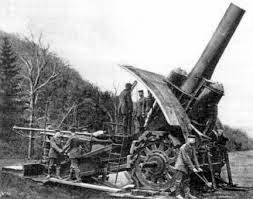
German artillery and aerial bombing began to intensify mid month. The enemy had brought in their long range heavy guns, the largest mobile artillery pieces in use by any army at the time. These 42 cm howitzers had demonstrated such destructive force at the outset of the war they earned the nickname Dicke Bertha, or Big Bertha, by the German Army. The shells weighed up to 1785 pounds and could project over a distance of almost six miles. Reports from solders say the shells were visible to the eye and sounded like a freight train hurtling through the air. The delayed action fuse could penetrate up to 40 feet of concrete and earth before exploding. The guns were disassembled for transport and reassembled in six hours, requiring a crew of 240 to service and man each gun. Hiding in the forest north of Ypres on April 18th was a Big Bertha Howitzer poised to systematically demolish one of the most beautiful ancient cities in Flanders. 


One of the first Big Berthas being prepared to fire

Ypres was bombarded relentlessly throughout April 18th, 19th and 20th. Hundreds of civilians and British troops were killed and wounded in the shelling and it became immediately too dangerous to stay. On the 20th the shelling was so severe the barracks had to be moved outside the city walls. The billeting accommodations in the Cloth Hall were evacuated. 

Adamson wrote to Mabel, “….a very heavy bombardment of the town: a shell fell in my billet backyard, killing two horses and one in the front, littering the whole room and scattering the lacemaking. About one o’clock they commenced firing 15 inch shells knocking down a large part of the town; the large square was littered with debris, and dead and wounded civilians, a great many women and children were killed and wounded. The whole town was a continuous stream of stretcher bearers carrying their loads. Brigade H.Q. badly shelled and moved to infantry barracks. At 4 p.m. we got an order to remove our men from the Infantry Barracks, where they were closely packed with Divisional troops. We took them to a vacant field outside the town and scattered them and watched the shelling of the town. Had it not meant so much to so many people, it would have been a magnificent sight.” 

Patircias worked around the clock helping the wounded and digging civilians out of the rubble. At night they brought food and water as shops were forced to close when the townspeople escaped to safety. Sewer and sanitation systems were destroyed quickly compromising living conditions. Fighting on the front lines had intensified as well and the men were given warning to stay in the Polygon Wood trenches and there they remained, without relief, for the next twelve days. 


Ruins at Ypres 

There had been rumours and warnings of a gas attack but there was a general belief among Allies the Germans wouldn’t use this deadly weapon in the west as the Hague Conventions of 1907 prohibited the use of "poison or poisoned weapons." The Germans had already used gas to great effect on the Eastern Front and the salient presented a perfect target for their next trial with chemical weapons to weaken Allied defences. Gas cylinders with simple hose extensions were installed opposite the French positions in early April. 

On April 22nd, at 5:00 pm, following a heavy bombardment, 168 tons of chlorine gas was released along a four mile front against two French divisions in the northern sector of the Ypres Salient. Canadians to the right witnessed a large yellow-green cloud sifting down from the sky, forcing French troops to flee from their positions. 

German troops penetrated a 4000 yard hole in the line, and advanced through masses of victims. Locals still living in nearby villages and farms were trapped by the toxic fumes with poison gas burning their eyes and lungs, causing respiratory distress and blindness. The Canadian Division was in disarray with telephone lines cut during the severe shelling. Their left flank was wide open yet, inexplicably, German forces halted after a 3,000 yard push into the French position.

Five miles down the line, Patricias, fortunately, were unharmed from the gas as they had not been issued adequate protection. They had been advised to prepare for attack. The Second Battle of Ypres had begun. 


Sunday, 19 April 2015

PATRICIAS TAKE UP POSITIONS IN THE TRENCHES OF POLYGON WOOD

The differences in approach to trench warfare were evident when the Canadians moved into new positions previously occupied by the French. Agar Adamson wrote to Mabel, surprised by the contrast, "It appears the French, who have been here for three months, had a pact with the Germans to live and let live, and did very little firing. When a Staff Officer of the Division came to look over the trenches, he found the French Captain in a very comfortable dugout 400 yards behind, he had never been in the advance trenches and had to get a guide to show him the way. Very different to our system, as yesterday afternoon Buller brought General Smith, a new Brigadier in the afternoon all through the 3 trenches"


British and Canadian officers were harshly critical of the French trench systems in 1915 which were incomplete, shallow and poorly protected. The French officers, relying heavily on their quick firing 75 mm guns, focused less on holding the line than preparing their infantry reserves for counterattack. Whereas the British defensive doctrine was to fully occupy and hold the line at all costs. As such, British criterion for trench design were of a much more rigorous standard than the French. The French routinely dug only two and a half feet down and were content with just one sandbag of depth for the parapet. Also frustrating were the lack of loopholes in the parapets which were essential for viewing and firing without exposing their heads to sniper fire. In spite of the handful of men killed and wounded each day in the line in early April, casualties were considered to have been light in comparison to the relentless and heavy casualties the Regiment suffered at St. Eloi. Many of these losses were due to a lack of diligence at the parapet.

P30(480)-1, PPCLI Originals wounded at Base, Sergeants with Drill Canes c. 1915, courtesy of PPCLI Museum and Archives

Although the decisive action at Vimy Ridge two years later would be credited with launching the birth of our nation, in the spring of 1915 a burgeoning sense of nationalism was emerging among the men. While enduring the unending horrors in the mud of St. Eloi the men had longed for the comforts of home. In quiet moments they escaped into their memories, finding solace in the tranquility of their homeland. So many of these men had been Englishmen living in Canada who, before the war, had not thought themselves as separate from their English countrymen. Once back in Europe, however, it became apparent they had become something other. The lure of the vast wilderness transformed adventurers and aristocrats alike. The easy style and informality of their new lives in Canada had changed their perspectives, even in higher societies. They were different now and a national pride was beginning to emerge. 

There are many stories of men whispering of Canada, of their love of the land, when they took their last breaths. Jack Munroe in his book, ‘Mopping Up’, describes his best friend Rob’s last words, the words he says of “a poet and a patriot; the words of a brooding spirit that had loved its land, and for that land had yielded up the supreme sacrifice”.

"I wish I was back in good old Canada now! Oh, I love the snow! Any place, any spot; from the Hudson Bay to the Great Lakes; from Prince Rupert to the Straits of Canso, would do me tonight. I'm sick of mud!"  No sooner had he expressed this nostalgic sentiment of home that an explosion mortally wounded his friend. With his last faint breath, “Canada....Canada....Canada! my heart...my love....Canada! …. Oh, God....Great Spirit of Truth...my soul....give it back to Canada....let it rest there....in peace, in purity....under the snow!"  

As he lay motionless Jack laments, "his spirit had fled in quest of the Northern Lights; to the silence and peace and purity of the snows."

In the months since leaving Salisbury Plain, the Patricias had not encountered any other Canadian units. As they were preparing in mid April to once again take up positions in the trenches of Polygon Wood, the Regiment were greeted and joshed by another battalion marching through the streets of Ypres. The PPCLI insignia inspired goading, clearly in admiration of the illustrious Patricias. As the men recognized the familiar accent and the cheerful, carefree manner in which these men in kilts conducted themselves their identity became unmistakable. It was a battalion of Canadians that taunted them. Every man instantly broke ranks and rushed to meet each other, against the stern orders of their officers. The mob of yelling and laughing Canucks, half in kilts and half in khaki, enjoyed their fellowship until they were ushered back to order. When darkness fell the Regiment marched again into the trenches of Polygon Wood directly in front of Ypres, along with the rest of the 80th Brigade and the 27th and 28th Divisions. To their left was the Canadian Division, including their new friends from the Scottish Regiment, deployed to the St. Julien sector. To the left of the Canadians were the French 45th Algerian Division. 

There were rumours the Germans would be launching an attack. Adamson wrote, “A prisoner that had been captured had given the information that we were going to be attacked, that gas in tubes was going to be used, that troops were massed in front of us for the attack. We are now supplied with fans and cotton wool soaked in something to revive us, if we are overpowered with the gas.” 


The Ypres Salient on 21 April 1915, showing unit dispositions

Friday, 10 April 2015

THE REGIMENT MOVES INTO THE YPRES SALIENT

Hamilton Gault had tried desperately to get back to his Regiment upon news of Farquhar's death but was under strict medical supervision and, much to his great disappointment, was not given permission to leave. As second in command, Gault was in line to replace the CO and command his beloved Regiment but the opportunity had been denied him. It was now up to Lieutenant-Colonel "Teta" Buller, Farquhar's lifelong friend and fellow member of the Vice Regal contingent from Ottawa, to follow in his legendary footsteps and he did so with stoic and courageous determination. 


Lieutenant-Colonel H.C. "Teta" Buller, D.S.O. 
Herbert Cecil Buller was the son of a British Admiral and aspired to be a career soldier from an early age. At 19 years of age he joined the Rifle Brigade and 29 had been promoted to Captain. At the time the Regiment was formed in August 1914, Buller was one of three British regular officers appointed to the PPCLI from the personal staff of the Governor General, The Duke of Connaught. As the Regiment's first Adjutant he supervised the crucial task of selecting the original battalion. 

A quiet period followed the harrowing events at St. Eloi at the end of March. The men settled into an interval of rest and, for the first time since arriving on the continent, the sun was warm and spring was in the air. So promising was the change of seasons that Adamson sent the matted and dirty shreds of his fur coat and waders back to Mabel.

On April 5th the Patricias arrived in Ypres and were assigned to billets in a large schoolhouse where hot baths and the first change of clothes in a month were a welcome relief. The officers were billeted in a Ladies University which provided some amusement evident in Adamson's letter to Mable describing the assortment of fine ladies clothing and undergarments hastily left behind. 

The city of Ypres was a thriving British and French garrison town in the spring of 1915. A popular tourist attraction and an important strategic landmark, it was also the target of determined German efforts to capture it over the next three years. Critical to the British hold on this sector of the Western Front, the Germans launched a major offensive against Ypres in November of 1914. The town was still relatively intact after the unsuccessful attack although some important landmarks had suffered massive damage. Undeterred, most of the 18,000 civilians continued to live in and around the town in spite of having lost over 250 people killed in the bombardment. The German shelling began to intensify in the area again come spring and in the early morning on April 6th, Germans shelled Ypres directly, killing and wounding 51 Royal Scots and several civilians.

When the Patricias occupied the town just the day before it was still bustling with markets and stores conducting business, almost oblivious to the war raging nearby. But the situation was quickly becoming more dangerous for the local people.


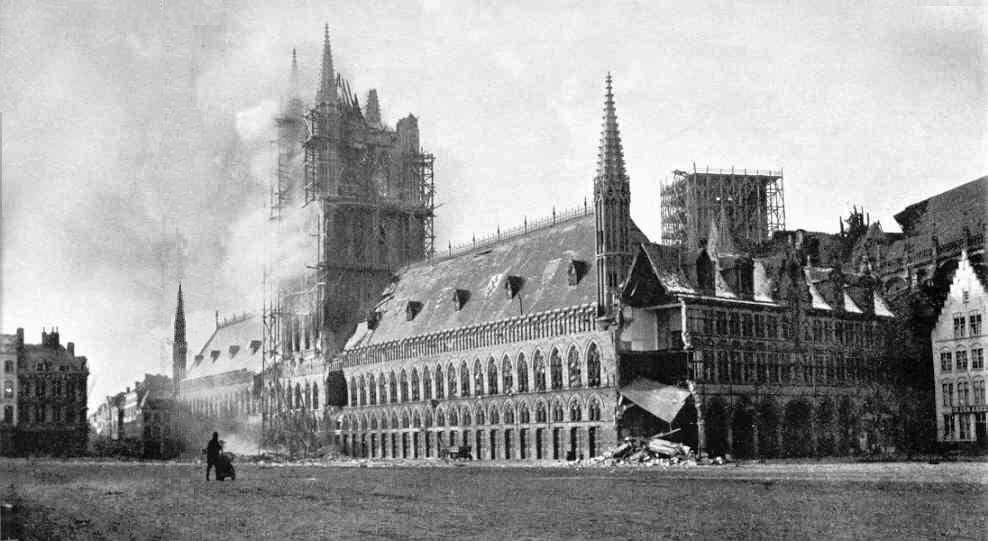
The Cloth Hall burning after a direct hit, Ypres, November 1914

Although the town was still functioning well, the destruction from the November shelling was a constant reminder of the possibility of another attack. The railway station and St. Martin's Cathedral had been badly damaged, among many other buildings, but the historic 14th century Cloth Hall had taken a direct hit. Famous for its gothic architecture, the Cloth Hall had been the original inspiration for the Centre Block on Parliament Hill. One of the largest commercial buildings of the Middle Ages, it was the main market and warehouse for the prosperous Flemish textile industry. Though the roof of the Cloth Hall had been demolished the walls were still standing and was being used to billet up to 1,500 men.

On April 7th the battalion again marched off for the trenches. Positioned in support trenches north-east of Hooge along the southern edge of Polygon Wood, this new location allowed the Patricias a brief respite from the appalling conditions of their previous duties. The trenches were fairly dry and with well sandbagged parapets. LtCol Buller described them as "paradise after St. Eloi."  The landscape surrounding Ypres was not yet destroyed by war and the Patricias were able to enjoy the picturesque countryside. The men were relatively safe here behind the line and wandered over to local farmhouses and village cafes to enjoy the comforts of community. 

Soon the second battle of Ypres would begin. This densely populated region of Belgium would have to be completely evacuated. The historic cities and towns would be subjected to devastating bombardments that would render them nothing more than piles of rubble. The pastoral lands and lush woods would be obliterated and churned into putrid muddy burial grounds. In spite of enduring four years of brutal warfare, remarkably, the city of Ypres never would fall into German hands.